
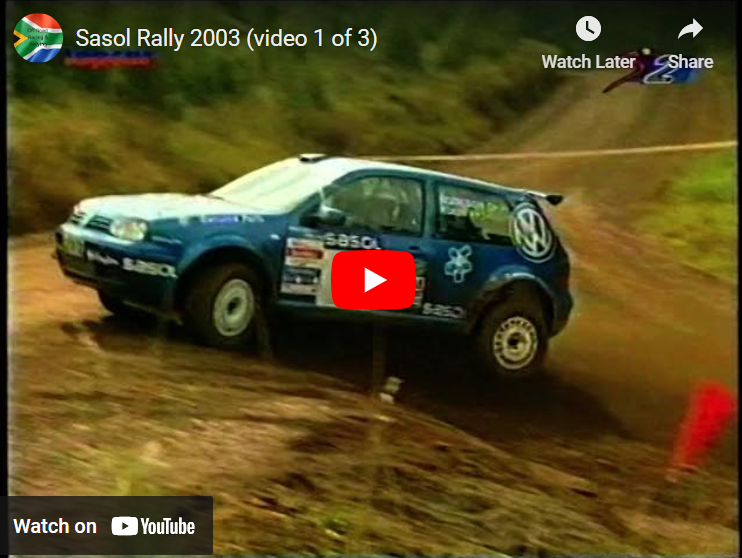
A metallic thud reverberates around the cockpit as the driver selects first gear from the sequential gearbox. My heart rate increases. A thin film of perspiration quickly forms on my palms. The driver blips the throttle once, twice. The revs begin to climb. The engine’s sound begins to roar. He drops the clutch, lets go of the handbrake and before I can count to six, we are travelling at more than 100km/h on the dirt. A few
short hundred metres later and the dirt road takes a gentle left curve and has a bump on the exit. At the speed we are travelling at, the curve seems more like a hairpin bend. I realise the driver does not intend to slow down. I take a deep breath and tense my muscles in anticipation of the expected crash. To my relief, it does not happen. We hit the bump, which sends the car airborne for a second before hitting the ground with a hard thud. This does not even slow the driver up; in fact, he is going even faster now. I look at the digital speedometer and all I can see is a terrifying number: 164. That is 164 km/h. I never expected that we were going that fast.
The year is 2003. The Sasol DualFuel Volkswagen Rally Team were testing their vehicles on dirt roads at St Albans near Port Elizabeth. I was invited along to the test day to go for a much-anticipated drive in a rally car. My driver was Jan Habig, then a four-time South African National Rally Champion (who would add the 2005 and 2007 national titles to his CV). The car I was driving in was the Sasol DualFuel Volkswagen Rally Golf 4. This combination of driver and vehicle has clinched two back-to-back South African National Rally Championships. South Africa’s most successful rally car in the last four years has been the Volkswagen Golf 4.
Initially introduced as a highly modified kitcar in 1999, the Golf has gone on to dominate the championship even in its more standard looking guise. Sixteen victories in twenty-four starts were achieved in the first three years, and then total domination followed in 2002, with Jan Habig and Enzo Kuun piloting the Golfs.
Jan Habig has won four drivers’ titles (1997, 1999, 2001, 2002) and Douglas Judd five co-drivers’ crowns – winning his extra title in 2000, when Habig finished second in that year’s championship.
Jan Habig is a family man. When he is not racing around gravel roads at speeds in excess of 200km/h, he spends his leisure time with his wife and three children in their hometown of Stanger. Owning several construction related companies and being a Volkswagen
factory rally driver, I would think his spare time is rather limited. “I have very little time to spend with the wife
and kids when I’m home because of my duties at my companies” said Habig. “So when I do see them, I make sure I
have plenty of quality time.”
His first event he competed in was the 1980 Midlands Rally in an old Datsun SSS 1600 where he finished ninth overall and first novice. “Highlights of my rallying career are the World Rally Championship (WRC) British RAC rally in 1994 in which I finished eighth overall; the WRC Rally Australia in which I finished sixteenth overall and winning a 200km long MotorPics Mountain Trial stage in 1999 by three
seconds” he said. His worst rallying moment was in the 1998 Stannic Cape Rally. In that rally, he was disqualified for a “petty infringement of the rules.” Asked what motivates him to rally, he said: “The competition and sense of achievement I gain form rallying, keeps
me doing what I love most. I have a very competitive streak, in that if I lose a rally (come second), then I will give it
110 % in testing and 200 % in the next rally. Personally, achieving victory is important. I am paid to win rallies for
Volkswagen and Sasol. Winning a stage, and a rally, in the most testing conditions, I feel a great sense of achievement
and purpose.”
“In this year’s championship, I think it is even more difficult, and therefore challenging, to win a rally because there are about five or six potential rally winners at each event. In last year’s championship, there were realistically only about two or three potential winners.
So this year, I think, the championship winner will most likely come from having the car that lasts the longest and can take the punishment.”
Volkswagen Racing Manager, South African-born Andre van der Watt, is highly regarded in international motor racing circles having been head of Volkswagen Racing International for five years. According to Mr van der Watt, the Golfs push out 190 kW of power and 235 Nm of torque. The car’s rev limiter is adjustable, but in its race trim the Golf’s rev limiter is set at 8 100 rpm. “The Golf, being a kitcar, is specifically designed and built to extract the best out of the car’s already great chassis (handling) and powerplant. These are most probably the only two things on this Golf that are similar to the production version.”
“When we began building this car, it was just a shell (the bare frame) with a roll cage. We have had to import the various parts and components from Volkswagen Germany’s motorsport division. The Golf uses a six-speed Gemini sequential gearbox. It is the latest in gearbox technology, making gear changes efficient and quick. The clutch is, of course, a racing clutch. The clutch is sturdily manufactured to withstand the extreme punishment of being between a high power engine and a sequential gearbox, under near impossible conditions.”
“Recaro racing seats keep the driver and co-driver comfortable and safe while doing their thing out in the bush. A six-point safety harness holds them in place. It can withstand the very high G-forces exerted on the drivers during an accident and offering them all round support in such situations.”
The inside of the Rally Golf is state-of- the-art. Every little wire inside the cockpit has been clipped down neatly. There is nothing loose or dangling in the car. Everything is spotlessly clean. There is not a single wire sticking out and there is weirdly no dust in the car
anywhere. There is an absolute lack of sound deadening material in the car. Every engine noise, every stone that hits the car is heard inside the cockpit. The dashboard vaguely resembles that of a production Volkswagen Golf. It has been considerably modified to house the digital speedometer, tachometer and the co-drivers navigational equipment of trip meters and clocks. There is no central console in the car. It now houses the gear lever and handbrake.
According to Jan Habig, the Golf can achieve a mind-blowing acceleration of 0-200km/h in 600m. “The top speed of the car is dependant on gearing. For a tight and twisty rally with few high-speed stages, I will use a shortrange gearbox. This improves the car’s acceleration and low-down power. For a high-speed rally, a long-range gearbox is used. The gearing is directed more at top speed than at acceleration as in the short-range gearbox. The top speeds of the car range from 180km/h to 220km/h, dependant on the gearing.”
“The Golf is an absolute pleasure to drive as it is so responsive,” said Habig. This I can vouch for, as when he took me for a drive, the total control he has over the car is overwhelming. When I drive on the highway, both my hands are on the steering wheel; when Habig drives his Golf at 160 km/h on the gravel, he has one hand on the steering wheel and the other on the gear lever.
The handling of the car is what really astounds me. Habig can do almost anything on the gravel and it seems that the car sticks to the gravel. This due to the traction the car has. “Without traction it is rather useless having all that power beneath your right foot,” Habig said. “For gravel stages, we use block treads. These tyres can be cut to add more tread patterns. The more effective the tyre is at going over the stones and at dispersing the little ones, the more traction the car has and therefore the quicker I can go. On tar stages, we normally use racing slick tyres. These tyres have no tread patterns because on tar the more tread patterns a tyre has, the less rubber there is on the tar. This, then, lowers the percentage of traction available to me.” The Golfs use 15-inch Bridgestone tyres for the gravel stages and for the tar stages, it has 17-inch Bridgestone tyres. According to Habig: “For the tar stages, the greater the tyre the more traction the car has. For gravel stages, we need smaller tyres. It is easier to control the car over the stones and through mud with a slightly narrower tyre.”
Racing down a gravel road, a sharp right hand corner is fast approaching us. The corner is now 100m or so away and he has still not taken his foot off the accelerator, yet alone started braking. With a quick half-turn of the steering wheel to the left (the opposite direction of the corner), the rear end of the car begins to drift outwards. He lightly pulls at the handbrake, turns the steering wheel to the right. The car is now magically going sideways into the corner; I can hardly see anything because of the plumes of dust the car is making. Habig nails the accelerator and we lurch forward at an incredible speed. He flicks through the gears; first, second, third, fourth and pulls the handbrake and we are drifting sideways into a left corner. Magic. As quickly as we enter the corner, we exit it. A few hundred metres down the road he hits the brakes and tells me he wants to practise a pull-away. We count down: 3, 2, 1…Go! In a normal car if you pull-away quickly, you are pushed into the back into the seat. In the Golf, you cannot feel this acceleration because of the racing seat and the six-point safety belt. You can only see the nose of the car lift and dip whenever Habig accelerates or decelerates. The sound in the car is deafening: all I can hear is the loud engine roaring and the sound of rocks hitting the undertray of the Golf. This I can hear through my padded helmet. The helmet has a built-in radio and microphone that enables us to communicate to each other over the other noises.
All the time that Habig is driving, he is asking me questions. I kept thinking that he should stop trying to have a conversation with me and drive the car. This shows the ability that these drivers have: while driving, he speaks to me, fiddles with the many various switches mounted on the dashboard and is constantly adjusting the car’s settings. To deal with the high speeds involved in rallying, the co-drivers have to feed road instructions to the drivers for two corners ahead of where they are currently are on the road. As the dictum goes: “If you have to think about what to do in the corner, you are too late.”
We approach the service area where the technicians eagerly await our arrival so that they can download the necessary technical data from our test. The euphoria of my drive will keep my adrenaline pumping for quite a few minutes after our drive and my wide smile will be there for many days to come. The deafening sound of silence is so overwhelming after the staccato sounds of rocks battering the undertray of the car and the screaming of the engine being pushed to the limits.
Read this in Issue 01 of Handbrakes & Hairpins.